Research
Why Pasteurized Akkermansia Muciniphila
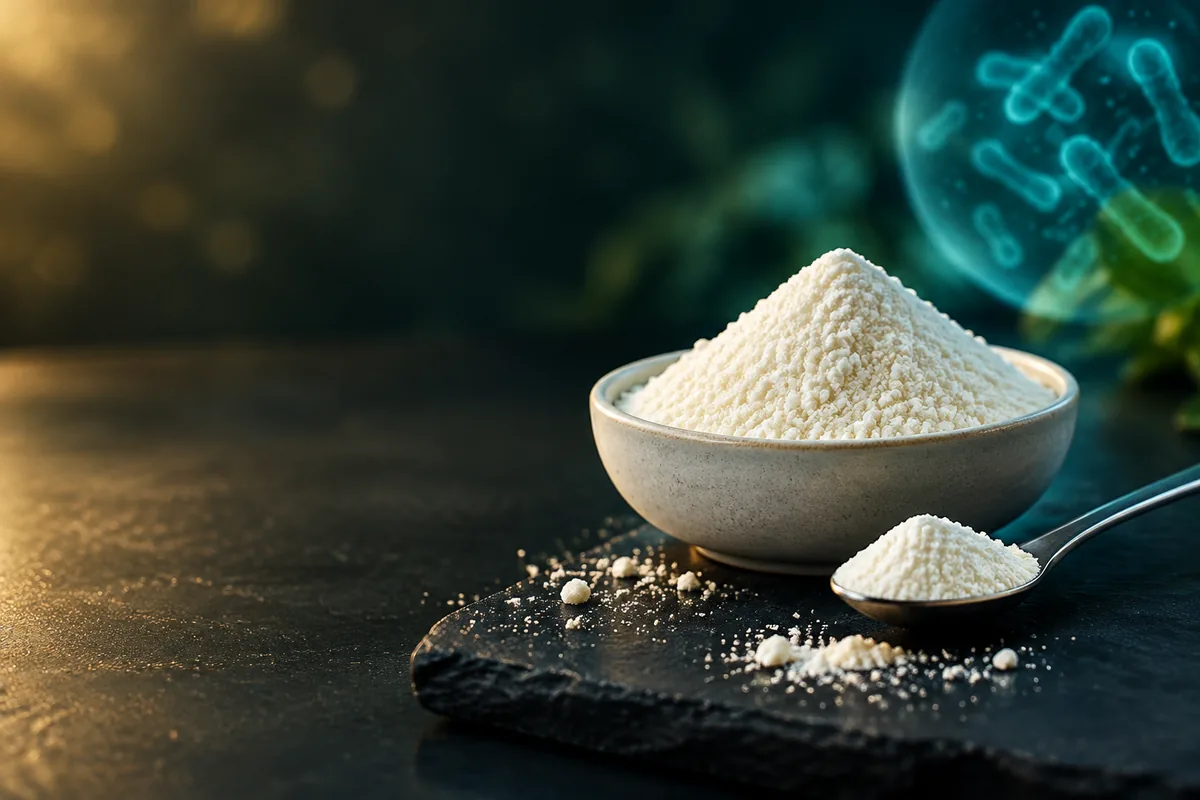
The species. Akkermansia muciniphila is a mucin-associated bacterium of the human gut and one of the most studied “next-generation” microbiome ingredients. It is a category of growing interest for gut-barrier and metabolic-health product concepts.
Why pasteurized. Heat-inactivated cells are stable at room temperature, need no cold chain and do not depend on survival through processing, which makes capsules, stick packs, gummies and beverages far easier to formulate than with a living culture. Compare formulation and regulatory differences in our guide: Pasteurized vs. Live Akkermansia: What Formulators Should Know. A randomized, placebo-controlled pilot study of A. muciniphila, including a pasteurized form (a different strain from ours), examined safety, tolerability and metabolic parameters in volunteers (Depommier et al., 2019, reference 1).
Marker proteins & biology. AKM Lab-01 is characterized by three outer-membrane or secreted proteins that are studied for gut-barrier and metabolic signalling: Amuc_1100, P9 (Amuc_1631) and Amuc_1409. Amuc_1100 is described as heat-stable, so it is retained after pasteurization, and every batch is released against an Amuc_1100 content of more than 60 ng/mg of total protein by mass-spectrometry quantification. For an overview of the science, potency metrics and regulatory background, read our explainer: What Is Pasteurized Akkermansia Muciniphila?.
Strain research. AKM Lab-01 was selected from 222 Akkermansia strains isolated from healthy human feces. Its published research to date is preclinical (diet-induced obese mouse models, plus a 90-day mouse safety study), see references 2 and 3. Human research is at an early stage: an internal 3-month pilot study (n=16, single-arm, no placebo) has been completed, and two registered clinical trials, NCT06974266 and NCT07331974, are ongoing research. We draw no efficacy claims from any of these.
Selected references
- Depommier C, Everard A, Druart C, et al. Supplementation with Akkermansia muciniphila in overweight and obese human volunteers: a proof-of-concept exploratory study. Nat Med. 2019;25:1096–1103. doi:10.1038/s41591-019-0495-2. Category background; a different strain.
- Huang B, Xian Y, Xue W, et al. Probiotic attributes and safety profile of the A. muciniphila strain AKM Lab-01 in diet-induced obese mice (title abridged). Front Microbiol. 2026;16:1627870. doi:10.3389/fmicb.2025.1627870. Preclinical.
- Huang B, Chen Z, Xue W, et al. A. muciniphila AKM Lab-01 combined with Garcinia cambogia extract in diet-induced obese mice (title abridged). Food Sci Nutr. 2026;14:e72140. doi:10.1002/fsn3.72140. Preclinical.
- EU regulatory context for the category: Commission Implementing Regulation (EU) 2022/168 authorizing pasteurized Akkermansia muciniphila as a novel food, following an EFSA safety opinion (2021).
Quality
Quality Control & Certifications
AKM Lab-01 is manufactured by our strain partner Moon (Guangzhou) Biotech Co., Ltd. under an FSSC 22000 certificate (SGS, scope as printed on the certificate) and carries an International Halal certificate. Moon Biotech is registered as a food facility with the US FDA (registration is not an FDA approval), holds the independent-panel self-affirmed GRAS conclusion, and has deposited the strain at DSMZ (DSM 35743), CGMCC (CGMCC 46611) and GDMCC (GDMCC 63782). It holds 8 granted patents (CN & HK) for strain AKM Lab-01 and Amuc_1100 methods, with further applications pending. These certificates belong to the partner, not to Tianyi. Numbers, scopes and validity dates are listed on Quality & Certifications. If you are auditing ingredient suppliers, review our checklist: How to Choose an Akkermansia Supplier.