Capsules
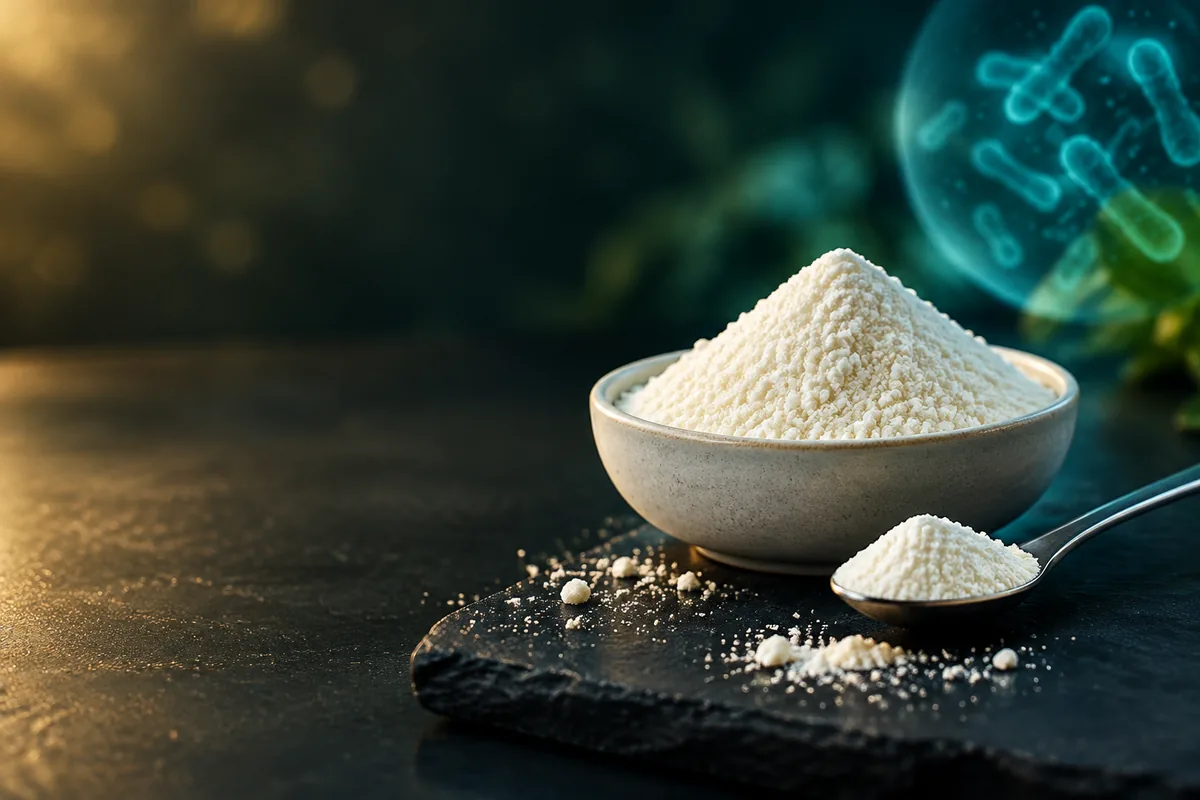
A fine powder of 60 mesh or finer. Run a flow and tamping check on your filling line and confirm fill weight against the grade you choose. The manufacturer’s internal pilot used an enteric capsule; ask us about capsule options.
 Tianyi Health Tech
Bulk powder · 36-month shelf life · Room-temperature storage
Looking for akkermansia powder in bulk? Tianyi Health Tech supplies pasteurized, freeze-dried Akkermansia muciniphila powder to supplement manufacturers, contract fillers and private-label brands, with batch COA, OEM/ODM support and sample lots for new brands. The powder is strain AKM Lab-01 from our manufacturing partner Moon (Guangzhou) Biotech, standardized by total cell count and released against a full chemical and microbiological specification.
Need the research story, marker proteins and regulatory background first? Read our Akkermansia muciniphila supplement ingredient page, or consult our guide on what pasteurized Akkermansia is.
Specification
| Parameter | Limit | Method |
|---|---|---|
| Physical properties | ||
| Appearance | Powder or granules, grayish white to grayish yellow, no visible foreign matter | Visual, 5 g on a white porcelain dish, natural light |
| Odor | Characteristic; no off-odor | Sensory |
| Particle size | 60 mesh or finer (manufacturer brochure) | |
| Moisture | ≤ 7.0% | AOAC 927.05 / 930.15 |
| Dispersibility | Disperses in water to a uniform suspension | Manufacturer description |
| Cell content and identity | ||
| Total cells (TFU/g) | Nominal grade 1.0×10¹¹ to 1.0×10¹²; see grade table below | MOA-UN-110 (in-house) |
| Culturable count | < 10 CFU/g (heat-inactivated) | MOA-UN-117 (in-house) |
| Species identification | 16S rRNA > 99% identity to A. muciniphila ATCC BAA-835 (NR_042817.1) | MOA-UN-029 |
| Amuc_1100 in total protein | > 60 ng/mg | MOA-UN-119 (MS MRM) |
| Heavy metals | ||
| Lead (Pb) | < 0.1 mg/kg | AOAC 2015.01 (ICP-MS) |
| Mercury (Hg) | < 0.1 mg/kg | AOAC 2015.01 |
| Cadmium (Cd) | < 0.3 mg/kg | AOAC 2015.01 |
| Arsenic (As) | < 0.3 mg/kg | AOAC 2015.01 |
| Microbiology | ||
| Total plate count | ≤ 500 CFU/g | ISO 4833-1 + Amd.1 |
| Sulfite-reducing anaerobes | ≤ 50 CFU/g | ISO 15213-1 |
| Coagulase-positive staphylococci | ≤ 10 CFU/g | ISO 6888-1 + Amd.1 |
| Enterobacteriaceae | ≤ 10 CFU/g | ISO 21528-2 |
| Coliforms | ≤ 10 CFU/g | ISO 4832 |
| Yeast / mold | ≤ 10 / ≤ 10 CFU/g | FDA BAM 18 / ISO 21527-2 |
| Bacillus cereus | ≤ 100 CFU/g | ISO 7932 + Amd.1 |
| Listeria monocytogenes | Not detected in 25 g | ISO 11290-1 |
| Salmonella | Not detected in 25 g | ISO 6579-1 + Amd.1 |
| Escherichia coli | Not detected in 1 g | ISO 7251 + Amd.1 |
| Supply | ||
| Shelf life | 36 months | Spec SP-FP-104 v04 |
| Storage | Sealed, room temperature; at least 10 cm off floor and wall; away from toxic, odorous, volatile or corrosive goods | Spec clause 5.6 |
| Documents | Specification sheet, batch COA and technical documents on request | |
Limits from the manufacturer’s specification sheet SP-FP-104 (v04). Batch release tests: sensory, moisture, total cells, culturable count, aerobic count, mold, yeast, 16S rRNA identity and Amuc_1100; a type test is run annually. The batch COA prevails over this table.
Grades
| Nominal grade (TFU/g) | Specified range (TFU/g) | Status |
|---|---|---|
| 1.0×10¹² | 1.0–3.0×10¹² | Featured grade |
| 2.0×10¹¹ | 2.0–6.0×10¹¹ | Featured grade |
| 1.0×10¹¹ | 1.0–3.0×10¹¹ | Lower end of the specification range; on request |
Because the powder is heat-inactivated, potency is stated as total cells: TFU (total fluorescent units) per gram, measured by an in-house total-cell count method. It is not a CFU figure and should not be compared with probiotic counts. The culturable count is held below 10 CFU/g by specification. Each grade has its own specified range, so the COA shows the measured value for your lot. For details on how total-cell potency relates to formulation stability, see Pasteurized vs Live Akkermansia. To evaluate supplier testing and batch documentation, read our Akkermansia Supplier Checklist.
Shelf life
The specification gives a 36-month shelf life with room-temperature storage and transport, and no cold chain. The development-lot data below show total cells and moisture unchanged through 6 months of accelerated and 12 months of long-term conditions. A liquid-system stability study (3.4×10¹⁰ TFU per 100 ml at pH 4–5 and pH 6–7) is also available on request.
| Parameter | Day 0 | 6 months, 40 °C / 75% RH | 12 months, 25 °C / 60% RH |
|---|---|---|---|
| Moisture | 1.5% | 0.91% | 1.5% |
| Total cells (TFU/g) | 1.1×10¹² | 1.0×10¹² | 1.1×10¹² |
| Culturable count | < 10 CFU/g | < 10 CFU/g | < 10 CFU/g |
Internal manufacturer data on one freeze-dried lot. Long-term data beyond 12 months are not shown here; the 36-month shelf life is the specification value.
Guide
A fine powder of 60 mesh or finer. Run a flow and tamping check on your filling line and confirm fill weight against the grade you choose. The manufacturer’s internal pilot used an enteric capsule; ask us about capsule options.
Dry-blend with carriers and flavors. Avoid humid blending rooms and keep moisture-sensitive partners (such as some effervescent systems) away from open powder, then verify the finished stick with a stability study.
Cells are inactivated, so there is no viability to protect, but depositing temperature, pH and water activity can still affect the matrix. A popping-boba gummy has been developed as a format example by the manufacturer.
The powder forms a uniform suspension in water. Add a stabilizer or suitable texture, test sedimentation and check a pH of 4–7 range, where liquid-system stability data exist.
Because the labeled metric is total cells, viability-loss overages are not needed in the way they are for living-bacteria products. Set your claim and overage policy from your own stability study, and keep the wording “pasteurized”.
Compatible in the manufacturer’s testing with plant extracts, vitamins, minerals, collagen and fish or krill oil. Pair with dihydromyricetin (DHM) powder or golden dark tea extract for blends.
Handling
OEM / ODM
Why Tianyi
Tianyi handles quotation, documents and export for AKM Lab-01 while the strain developer manufactures it.
Combine Akkermansia with DHM, vine tea, golden dark tea or cyclocarya polyphenols from the same supplier.
Quality
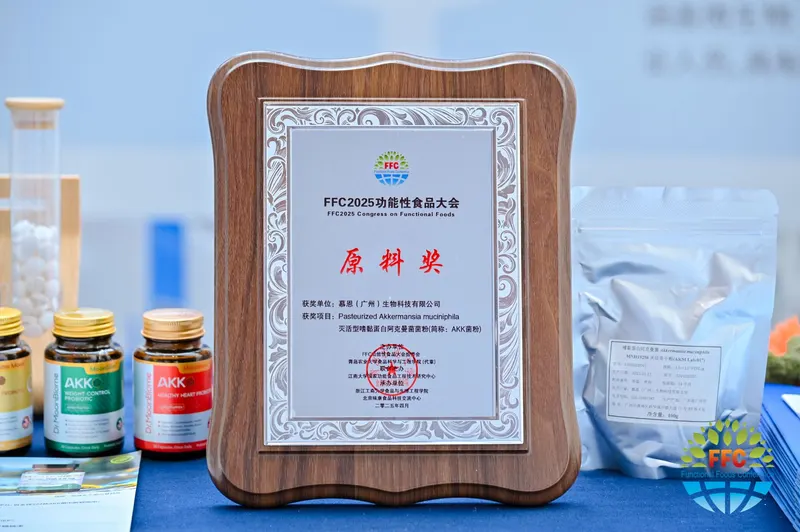
The powder is made by Moon (Guangzhou) Biotech Co., Ltd., which holds the FSSC 22000 certificate (SGS) for its fermentation and freeze-drying operation, an International Halal certificate and a US FDA food facility registration (registration, not approval). Strain deposits are DSM 35743, CGMCC 46611 and GDMCC 63782. An independent expert panel reached a self-affirmed GRAS conclusion in 2025. All of these belong to the manufacturer; see Quality & Certifications for numbers, scope and validity.
Selected references
More ingredients
FAQ
TFU is total fluorescent units, a total-cell count (in-house SOP MOA-UN-110). It counts all cells in the powder, whether or not they could grow, which is the appropriate metric for a heat-inactivated ingredient. It is not comparable with probiotic CFU. See our explainer: What is pasteurized Akkermansia?.
No. It is pasteurized, then freeze-dried, and the specification limits the culturable count to below 10 CFU/g. Please do not label it as a live-bacteria product. Compare formats in our pasteurized vs live guide.
The featured grades are 2.0×10¹¹ and 1.0×10¹² TFU/g. The specification also defines other nominal grades within 1.0×10¹¹ to 1.0×10¹² TFU/g, so ask if you need a specific target.
Keep it sealed at room temperature, in a dry store, at least 10 cm off the floor and walls, and away from toxic, odorous, volatile or corrosive goods. Reseal the pack promptly after opening. Shelf life per the specification is 36 months.
The manufacturer describes the powder as easily dispersing in water to a uniform suspension, with a particle size of 60 mesh or finer. It is a suspension, not a solution, so test sedimentation and mouthfeel in your own beverage base.
The manufacturer states that all production materials are food-grade, non-animal-derived and free of allergenic ingredients. Request the formal allergen statement for your file.
Request a quote
Last updated: 13 October 2026
Research and clinical information is provided for R&D and B2B reference only. These statements have not been evaluated by the Food and Drug Administration. Our ingredients are not intended to diagnose, treat, cure or prevent any disease. Final specifications and regulatory status are confirmed per commercial agreement.